

Audience research
Part of Researching buyers, operators and affected people separately for privacy first measurement
Measurement buyer personas as cited role summaries, with dissent and review dates
Five cited role summaries cover budget, implementation, assurance, insight and finance owners, with tools, dissent and review dates for privacy-first measurement.
Useful privacy-first measurement buyer personas are cited role summaries, not invented characters with names, hobbies and stock photographs. Each card shows a real decision role, the proof that changes its choice, and the dissent that remains.
This page carries five worked cards. They use public sources, not customer interviews, surveys or usability sessions. No purchasing outcome is claimed. Review date: 5 September 2026. Sources were checked at that date.
If you cannot run customer interviews, use public sources instead. These include regulator guidance, government service manuals, vendor pricing pages, product documentation, and your own analytics or search console data. Sales or support notes you already hold can also help if you have permission.
What to take away
- Build each card from cited evidence, not invented character detail.
- Map every role that can change the decision, including money, operations, risk and output consumers.
- Record opposing or missing evidence on the card instead of averaging it into a fictional middle person.
- Keep personal detail out unless it does work, because extra attributes create stereotypes and identification risk.
- Label the evidence boundary, including geography, sample composition and whether the card is provisional.
Five cited role summaries
Commercial owner. Controls ecommerce analytics budget. Evidence: the Information Commissioner's Office (ICO) lists purpose limitation, data minimisation and storage limitation among the UK GDPR principles. The Government Digital Service (GDS) planning guide says teams should create personas as they learn.
Source: ICO Guide to the UK GDPR principles and GDS planning guide; date range: current at page review date; sample: no survey sample, UK.
Tools:
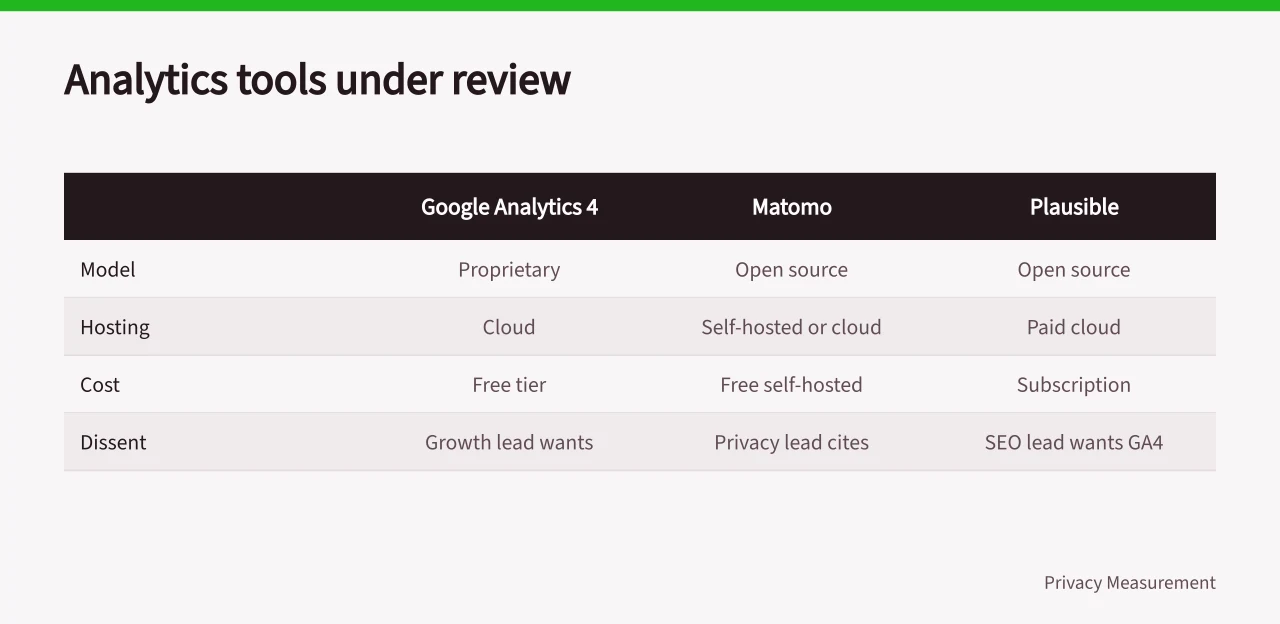
- Google Analytics 4hosted by Google, uses cookies by default with Consent Mode, free with paid Analytics 360.
- Matomoself-hosted or Matomo Cloud, first-party cookies by default with cookieless option, free self-hosted and paid cloud plans.
- PlausiblePlausible cloud hosting, cookieless by default, paid per-site subscription.
Dissent: a growth lead wants Google Analytics 4 and Meta Pixel for retargeting; a privacy lead cites data minimisation. Decision: pilot Matomo with server-side tagging. Owner: head of ecommerce analytics.
Implementation lead. Runs tags, events and consent. Evidence: GDS guidance on analysing a research session treats raw notes as inputs to analysis. Source: GDS analysing a research session; date range: current at page review date; sample: no survey sample, UK government service teams.
Tools:
- PlausiblePlausible cloud hosting, cookieless by default, paid per-site subscription.
- Fathom Analyticscloud hosted by Fathom, cookieless by default, paid monthly per site.
- Matomoself-hosted or Matomo Cloud, first-party cookies by default with cookieless option, free self-hosted and paid cloud plans.
Dissent: an SEO lead says Google Analytics 4 is needed for Search Console reports. Decision: use Plausible on the marketing site and keep Google Analytics 4 in the product. Owner: marketing technology lead.
Assurance reviewer. Assesses risk before approval. Evidence: ICO Guide to the UK GDPR principles; date range: current at page review date; sample: no survey sample, UK.
Tools:
- Piwik PROEU cloud or private cloud, first-party cookies with consent manager, commercial subscription.
- Matomoself-hosted or Matomo Cloud, first-party cookies by default with cookieless option, free self-hosted and paid cloud plans.
- Google Analytics 4hosted by Google, uses cookies by default with Consent Mode, free with paid Analytics 360.
Dissent: a chief technology officer says self-hosted Matomo is cheaper. Decision: require a data protection impact assessment for any choice. Owner: data protection officer.
Insight consumer. Turns measurement into reports and decisions. Evidence: GDS guidance on analysing a research session; date range: current at page review date; sample: no survey sample, UK government service teams.
Tools:
- Snowplowself-hosted or Snowplow cloud, first-party cookies by default, open source self-hosted and paid cloud.
- Segmentcloud hosted by Twilio, uses cookies and local storage, subscription based on volume.
- Google Analytics 4hosted by Google, uses cookies by default with Consent Mode, free with paid Analytics 360.
Dissent: a business intelligence team prefers Google Analytics 4 because it is familiar. Decision: define one event schema before buying. Owner: analytics manager.
Finance or procurement owner. Checks total cost and contract terms. Evidence: public vendor pricing pages and ICO Guide to the UK GDPR principles; date range: current at page review date; sample: no survey sample; vendor pricing is global unless stated.
Tools:
- Matomo Cloudcloud hosted by Matomo, first-party cookies by default with cookieless option, paid subscription.
- PlausiblePlausible cloud hosting, cookieless by default, paid per-site subscription.
- Fathom Analyticscloud hosted by Fathom, cookieless by default, paid monthly per site.
Dissent: marketing wants the free Google Analytics 4 tier; finance notes the staff time needed for consent and reporting. Decision: budget for one paid privacy-focused tool. Owner: finance business partner.
Keep the dissent and review date
Each card needs a role, experience and decision context. Record the need, source, date range and opposing evidence for every statement. Add the decision and an owner. A bounded statement names the study and sample.
Role summary card fields
- Role and relevant experience
- Decision context and owner
- Need, source and date range
- Opposing evidence and dissent field
- Cases that do not fit
- Next round to resolve gaps
Add a dissent field instead of averaging reviewers into a fictional middle person. Worked format: "Dissent: [role] claims [position]; [counter-evidence] suggests [risk]; status: unresolved, owner [role], next review after pilot." State which cases do not fit and whether the gap reflects sector, scale, data type or uncertainty. A low frequency but severe risk stays visible.
Before you act
- Start with roles that can change the purchase decision.
- Give every statement a source and date.
- Add a dissent field for cases that do not fit.
- Drop personal detail that does no work.
- Revise the card when new evidence contradicts it.
Common questions
What should a persona card contain instead of invented character detail?
Each card should carry a role, relevant experience and decision context. For every statement, record the behaviour, source, date range and opposing evidence. Add the decision it informs and an owner with a review date.
How should a team handle disagreement between people in the same role?
Do not average differences into a fictional middle person. Add a dissent field to each card. State which cases do not fit, whether the disagreement reflects sector, organisational scale, data type or uncertainty, and what a next round could resolve.
Which tools can support privacy-first measurement?
Google Analytics 4, Matomo, Plausible, Fathom Analytics and Piwik PRO appear above. Snowplow and Segment also appear. Check current vendor terms, hosting location, cookie behaviour and consent mode before buying. Public pricing changes, so confirm at renewal.
What data protection points apply when a role card uses identifiable notes?
The ICO lists purpose limitation, data minimisation and storage limitation among the UK GDPR principles. If a card draws on identifiable notes or recordings, document access, retention and the processing basis.