

Outlook
What is actually known about measurement going into 2027, and what still is not
Measurement planning for England in 2027 uses observed evidence, bounded scenarios and explicit update triggers instead of invented market predictions.
A sound privacy first measurement outlook for an organisation in England is a controlled plan, not a numerical prediction.
Editorial scenario: During 2027, a team may face new platform controls, more modelling proposals, evolving regulatory interpretation and greater security pressure.
Current evidence supports preparing for those. It does not support an England market size, adoption rate, revenue figure or guaranteed privacy result.
The research desk checked outlook sources on 5 September 2026, and forward-looking material is labelled so readers can see where evidence ends.
Observed evidence is a dated primary record. A supplier announcement covers the publisher's own product, not independent validation.
An attributed forecast keeps the publisher, geography, horizon and method limit, and an editorial scenario is a bounded planning case.
Shared reopening rule: a revised source, a new ONS release, a supplier notice or a new purpose reopens the decision it affects. The same applies to a new recipient, identifier or user route, a changed configuration, population or model, or a break in source-to-report reconciliation. The owner records the date, the evidence and the outcome.
The organisation must recheck each live source on publication day. Named privacy, PECR, legal, security, statistical, AI and commercial reviewers remain required. No system, model, account, contract or incident process was tested for this article.
What to take away
- Treat each storage or access operation as a record with technology, purpose, recipient, consent or exception decision, objection behaviour, owner and last test.
- Count your own production uses of AI, their tested boundaries and unresolved risks instead of borrowing an adoption percentage.
- Archive configurations, supplier notices and test results with the metric release so reports are reproducible.
What is actually known in September 2026
UK rules changed, but purposes still decide the route
Observed evidence: the ICO published final storage and access technologies guidance on 29 April 2026 following consultations and changes introduced by the Data (Use and Access) Act. The guidance covers cookies, pixels, device fingerprinting and similar technologies, with UK scope.
Storage or access decision route
Does the operation have a sole statistical purpose?
statistical exception with clear info and free objection
consent or another valid exception required
ICO: final storage and access technologies guidance published
That publication is not permission for every analytics design. The ICO's detailed exceptions page says the statistical purposes exception has a sole-purpose condition and requires clear information plus an easy, free objection route. Where the conditions are not met, an organisation cannot rely on that exception.
ICO: what are the exceptions?
For 2027 planning, treat each storage or access operation as a record with technology, purpose, recipient, consent or exception decision and objection behaviour. Log owner and last test.
An illustrative record, not a client case:
UK rules changed
- Technology
- first-party script on a checkout page
- Purpose
- aggregate completion count for service monitoring
- Recipient
- internal warehouse, no external transfer
- Consent or exception decision
- statistical purposes exception, sole purpose recorded
- Objection behaviour
- free objection route offered, opt-out honoured on the next page load
- Owner
- named measurement lead in the register
- Last test
- consent-state reconciliation against the approved configuration
Keep the PECR assessment separate from UK GDPR analysis of personal-information processing.
A lawful-basis decision does not make a device operation permissible; an exception does not settle everything done with resulting information.
UK businesses report more AI use, not universal depth
Observed evidence: ONS published a July 2026 analysis using BICS and other material. It reported that self-declared use of at least one AI technology had increased among UK businesses, but the average number of technologies used per adopting business had risen only modestly. Much of the trend focuses on businesses with 10 or more employees. ONS also notes that adoption estimates vary with the question and population.
ONS: artificial intelligence in UK businesses, 2023 to 2026
This is not evidence that England measurement teams will adopt a named technique, nor that AI improves their accuracy or productivity. It is a UK capability signal. A business should count its own production uses, their tested boundaries and unresolved risks instead of borrowing an adoption percentage.
Product configuration is part of the evidence chain
Supplier announcement: Google states that, beginning 15 June 2026, it changed how specified Google Analytics and Google Ads settings control data collection and use. Its notice also says more dates would follow for later changes. This establishes a Google product dependency only. It is not ICO guidance, independent performance evidence or a forecast for other suppliers.
Google Analytics: updates to data controls
The operational lesson is broader but remains an editorial judgement: a report is not reproducible when administrators cannot reconstruct collection, consent-state behaviour, account links and model settings for the relevant period. Archive configurations, supplier notices and test results with the metric release.
Five 2027 decisions: measure survival, modelling entry, team capability, security evidence and revision
Decision 1: which measures deserve to survive?
Editorial scenario: specialist time and budget remain constrained while collection grows. Begin with the decisions the organisation actually makes. For every measure, state event, population, numerator, denominator, unit, period, time zone, inclusions, exclusions, data owner and caveat. Retire a field that has no decision owner or proportionate use.
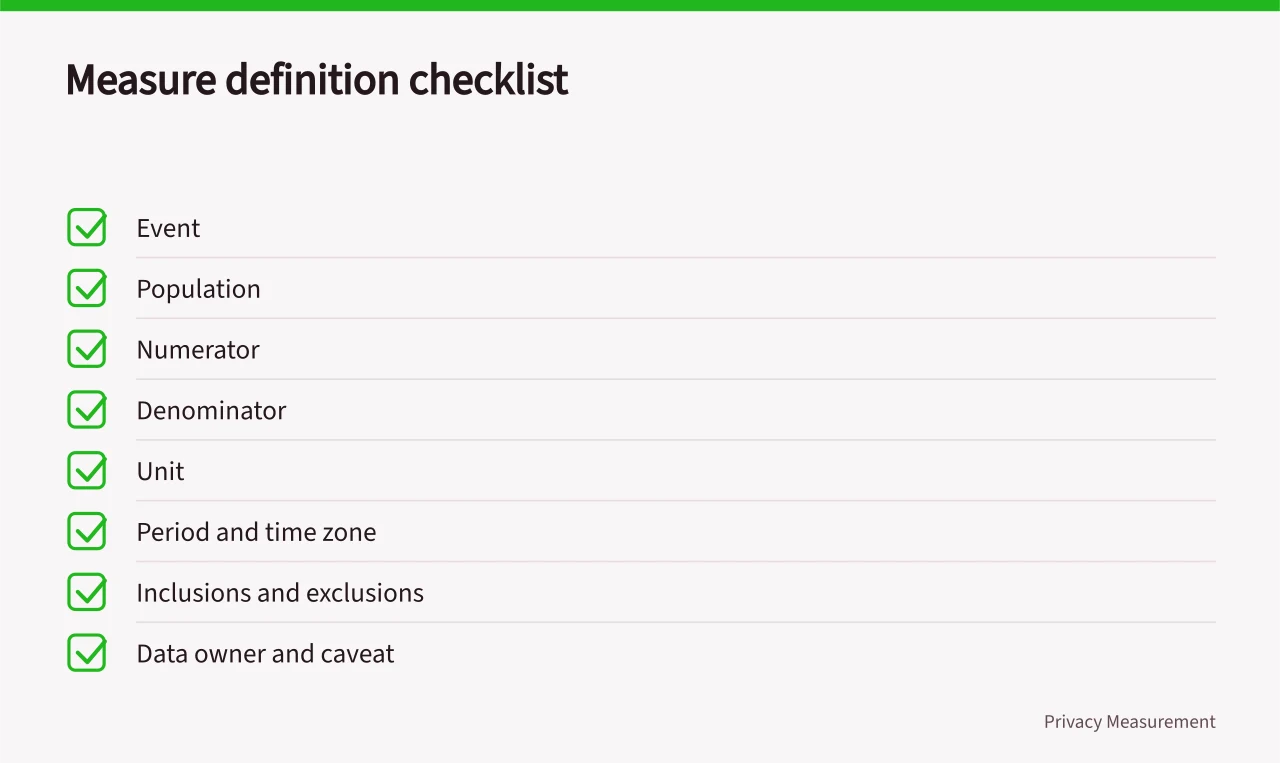
This is not a call to minimise data blindly. It is a demand for purpose and quality to meet. If removing a field prevents a critical control or service decision, document that case. If an optional enrichment creates review work without changing any action, it is a candidate for removal.
Update trigger (shared reopening rule): a measure gains or loses a named decision, its user population changes, or the cost and risk of maintaining it cross the agreed tolerance.
Decision 2: where can modelling enter safely?
Editorial scenario: the team proposes anomaly detection, classification help or a modelled aggregate to handle incomplete observations. Start with a shadow output. Define the correct label or comparator, training and test windows, affected population, error measures, uncertainty and stop rule. Keep observed and modelled values visibly separate.
The ICO distinguishes personal-data accuracy from statistical accuracy. It also warns that an overall accuracy proportion can mislead when classes are imbalanced or performance differs in context.
ICO: accuracy and statistical accuracy in AI
The 2025 AQuA Book adds an analytical assurance discipline: verification asks whether analysis meets its specification, while validation asks whether it is fit for its intended use. It calls for proportionate assurance, uncertainty treatment, versioning and continuing review, including black-box systems.
Do not translate a modelled attribution into causal incrementality. Attribution allocates credit under a rule or model. Causal evidence asks what happened because of an intervention. Neither establishes business value until the organisation links the result to a decision and verifies the relevant costs and outcomes.
Update trigger (shared reopening rule): a model, prompt, data source, population, threshold or intended use changes; validation fails; or subgroup performance crosses its hold limit.
Decision 3: what capability should the team build?
Attributed forecast: DSIT-commissioned research published in January 2026 adapts Working Futures with patent and vacancy evidence to explore UK AI-related employment through 2035. It presents conditional scenarios, identifies implementers as a large expected group and stresses the combination of AI and sector knowledge. The report describes experimental choices and says annual demand can fluctuate.
UK AI skills scenarios through 2035
It cannot supply a 2027 headcount, vacancy or salary forecast for this niche in England. Use it to test a qualitative proposition: implementation and domain judgement may matter alongside specialist modelling.
Editorial scenario: organise work around four capabilities. A privacy and PECR reviewer resolves permission boundaries. A measurement engineer builds traceable events and reconciliation. A statistician challenges estimates and uncertainty. A security and AI owner controls model dependencies, access and rollback. These are responsibilities, not necessarily four jobs.
Assess skill with a controlled exercise using synthetic or appropriately protected data. Ask the team to trace a consent-state journey, diagnose a planted schema fault, explain a model limitation and restore the approved configuration. Record what was not tested.
Update trigger (shared reopening rule): repeated operational failure, a new high-risk use, loss of independent challenge or a material revision to labour evidence.
Decision 4: how much security evidence is enough?
Attributed forecast: in May 2025, the NCSC assessed UK cyber threats through 2027. It said AI would almost certainly make elements of intrusion more effective and reduce the time between some vulnerability disclosures and exploitation. This is an intelligence assessment with UK scope, not an incident probability for an analytics stack.
NCSC: AI cyber threat assessment to 2027
NCSC's secure AI development guidance covers design, development, deployment, operation and maintenance, including systems built on hosted models or external APIs.
NCSC: guidelines for secure AI system development
Editorial scenario: shorten the interval between a supplier alert and an owner decision. Maintain dependency inventory, access review, log retention, patch route, isolation procedure and clean recovery test. Do not claim resilience because a provider cites a code or because a tabletop exercise passed.
Update trigger (shared reopening rule): a material vulnerability, dependency update, control failure, incident, threat-assessment revision or loss of a recovery artefact.
Decision 5: when should a reported result be revised?
Editorial scenario: a source update or correction changes the sign or scale of a reported movement. Preserve the original release, mark it superseded, publish the reason and notify the decision owner. Recalculate only the affected period unless the method change has wider reach.
ONS distinguishes revisions that incorporate better methods or later data from corrections that fix errors. Its policy governs ONS statistics, but the distinction is a useful pattern for internal measurement records.
ONS: revisions and correction of errors policy
Update trigger (shared reopening rule): a source revision, metric-definition change, reconciliation outside tolerance, discovered calculation error or model retraining.
A bounded operating plan for England
Use three planning cases and do not assign probabilities unless evidence supports them.
Steady editorial scenario: the regulatory and supplier environment stays materially stable. Maintain routine tests, quarterly source checks and a small change reserve. Stop low-value measures whose ownership expires.
Change-heavy editorial scenario: one or more suppliers alter controls while the business introduces a new use. Protect privacy, engineering and statistical review time. Hold release until permission records, test journeys and reconciliation agree.
Constrained editorial scenario: money or specialist capacity falls. Preserve lawful operation, security response and decision-critical measurement. Defer optional enrichment and unvalidated modelling. Cash spending, internal labour, implementation, support and exit costs should remain separate in the planning model.
For each case, record the base date, assumptions, owner, indicators, review cadence, stop condition and reversible action. Useful internal indicators include unresolved data-flow changes, failed consent-state journeys, source-report discrepancies, provisional metrics, open vulnerabilities and decisions waiting for evidence. They are operational counts, not industry benchmarks.
Publication and review gate
Before this outlook moves beyond editorial hold:
- the fact-checker must reopen every source and confirm date, geography and current wording;
- a privacy and PECR specialist must review collection and processing distinctions;
- a statistician must check model, uncertainty, attribution and causal boundaries;
- a security specialist must examine dependencies and incident claims;
- an AI reviewer must check intended use, test evidence and human control;
- legal and commercial reviewers must assess contracts, promises and decision consequences.
The final decision record should say what changed, what did not, which scenario is active and what would reopen it. That makes a 2027 outlook useful without disguising uncertainty as foresight.
Common questions
What does the ICO guidance on storage and access technologies cover?
The ICO published final guidance on 29 April 2026 covering cookies, pixels, device fingerprinting and similar technologies with UK scope. It is not permission for every analytics design. The statistical purposes exception has a sole-purpose condition and requires clear information plus an easy, free objection route.
What did the ONS July 2026 analysis find about AI use in UK businesses?
ONS reported that self-declared use of at least one AI technology had increased among UK businesses, but the average number of technologies used per adopting business had risen only modestly. Much of the trend focuses on businesses with 10 or more employees. Adoption estimates vary with the question and population.
How should a team approach modelling for 2027?
Start with a shadow output. Define the correct label or comparator, training and test windows, affected population, error measures, uncertainty and stop rule.
In this guide
- Which measures fit the ICO statistical exception in England, and which need consentSort England analytics measures against the ICO statistical purposes exception: aggregate counts that fit, tracking and conversion sharing that need consent.
- Four bounded uses of AI in measurement, with test sets and stop rulesMeasurement teams can assess four bounded AI uses through explicit inputs, test sets and stop rules while keeping privacy permission and accuracy separate.
- Planning measurement demand without inventing a growth rateMeasurement demand in England can be planned through regulatory, platform and capability signals without fabricating a 2027 market size or growth rate.
- Test measurement skills with a practical exercise, not a certificateCheck measurement capability with a one-event practical exercise across four skill bundles, then record the result in a capability matrix, not a job title.
- Five measurement risks to rehearse before 2027, from silent platform changes to reversed decisionsMeasurement teams can rehearse five bounded 2027 risks with observable triggers, named owners and stop conditions without predicting an incident.